
Wednesday, May 20, 2009
Our Nation's Power
NPR created a great graphic on our nation's power grid. It maps out our current power usage and shows our future capacity for solar and wind power.


Green House
Clayton Homes has introduced a home that is stylish, innovative, environmentally friendly, and affordable. The homes cost approximately $100 per square foot and the cost of living is low since the energy savings of having a home with solar panels, energy efficient windows, and a rain water catchment system is usually large. According to the manufacturer, it only costs a $1 a day in energy costs to run utilities. Surprisingly, it also looks comfortable with bamboo floors, a lot natural light from windows, and a modern kitchen. They call it an i-house.
Here are some of the features of the i-house.
And here is a virtual tour of their houses.
Here are some of the features of the i-house.
And here is a virtual tour of their houses.
Thursday, April 16, 2009
A Vision for High Speed Rail
 This is a very exciting project--it'll improve our rail system, decrease our automobile dependency, provide a variety of people with access to travel they would not normally have, and increase economic and commercial development along the routes.
Tuesday, April 14, 2009
Health Gadgets: CardioTrainer

Cell phones are now being used to keep healthy. Android phones, like the G1, allow users to download applications made by developers. One application made by WorkSmart Labs, called CardioTrainer, allows users to track their workouts. It will record your jogging, biking, or hiking route and give you detailed information about how far you went, what your average speed was, and how the elevation changed throughout the route. It's a great program to help you keep track of your workout goals. You can even send your route to Google Maps and share them with your friends, like this Myakka hike-
View Myakka in a larger map
Ugly Statistics
Timothy Noah at Slate.com, wrote a very interesting article on the importance of health care reform.
It starts here: "Between 1999 and 2008, employer-sponsored health insurance premiums increased six times faster than wages."
Here is a graph from the U.S. Department of Health & Human Services--
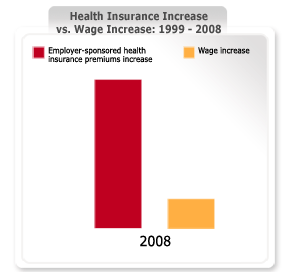
Based on the families I've talked to, this graph accurately represents our health care reality.
Timothy notes what this means for the average worker, "Whatever pay increases the average worker received were wiped out, and then some, by the rapidly growing amounts deducted from his paycheck to cover health insurance." Wages have not increased in proportion to health care costs. Instead, health care costs have increased tremendously over the past ten years, making it harder for Americans to afford adequate care.
It starts here: "Between 1999 and 2008, employer-sponsored health insurance premiums increased six times faster than wages."
Here is a graph from the U.S. Department of Health & Human Services--

Based on the families I've talked to, this graph accurately represents our health care reality.
Timothy notes what this means for the average worker, "Whatever pay increases the average worker received were wiped out, and then some, by the rapidly growing amounts deducted from his paycheck to cover health insurance." Wages have not increased in proportion to health care costs. Instead, health care costs have increased tremendously over the past ten years, making it harder for Americans to afford adequate care.
Sunday, April 12, 2009
NPHW Day 7: Wrap-Up
National Public Health Week comes to an end today. If there is anything we learned it is that public health is an important and diverse field. This week, we have focused on communities, climate change, workplace health, and health at schools.
In the beginning of the week, we tried to illustrate how broad the public health field is by showing you three random pictures and asking what they have to do with public health. We covered the first picture of suburbs here.
One other picture was a music player.

Public health departments across the world have started to experiment with using music to help communicate health messages. Music is such a strong part of any culture, so if health concepts can become attached to this facet of society, public health might become better integrated into communities. Health is often seen as a separate entity or industry, but so many things in our community affect our health. Using music to demonstrate the importance of this has been a new way for health to become more salient.
Additionally, music activism has become a popular way of communicating health messages. Popular performers can raise the attention of certain health issues by encouraging listeners to promote health. Take a look at the 2007 Unite Against AIDS Concert. Music artist, Bono, has been using his popularity to help increase awareness and efforts for a variety of global health issues, such as AIDS.
The last image was an airplane.

The inspiration for this image came from President Obama who strongly supports a global public health infrastructure since "these days, a pandemic can get on a plane" and be in America overnight. Airline travel has brought diseases halfway across the world to our doorstep. President Obama notes public health is our way of preventing and protecting the world from global health issues.
Saturday, April 11, 2009
NPHW Day 6: The Sunshine State
Today we are going to focus on a local public health story that has made headlines around the world. Florida Power & Light is starting a project to create a solar-powered city, the first in the world.
"Called Babcock Ranch, the city will aim to build 19,500 houses and about 6 million square feet of retail, light industrial, and office space when it is completed, the developers said." --Reuters
The clean energy project has so many benefits, starting with creating 20,000 new jobs in Florida and then reducing energy costs for city residents and businesses while decreasing the amount of pollution in our atmosphere.

Subscribe to:
Posts (Atom)